- Apple Watch for students
- flashcards
- study tips
- spaced repetition
How to Study Flashcards on Apple Watch
By Kalyani Lokireddy
Apple Watch is a poor place to read and a surprisingly good place to test yourself. Flashcards work on a wrist for the same reason long articles do not: a card is meant to be seen in a glance, answered from memory, and dismissed. That is a two-second interaction, and two-second interactions are what a watch is for.
The catch is that most people's existing cards are not built for it. Here is what to change.
Why does retrieval practice suit a watch so well?
The evidence on retrieval practice — testing yourself rather than rereading — is among the most consistent findings in learning research. Trying to recall something strengthens the memory more than reviewing the same material passively.
Rereading needs sustained attention and a large screen. Retrieval needs neither. It needs a prompt, a pause, and an answer, which fits the exact shape of the moments a watch is available in: a lift, a queue, the two minutes before a lecture starts, waiting for a kettle.
Those moments are otherwise dead time, and they add up to more study than most people expect — twenty scattered sessions of ninety seconds is half an hour of active recall you would not otherwise have done.
What makes a card work on a small screen?
One idea per card, phrased as a question, answerable in a word or a short phrase. That is stricter than most decks people already have.
- Question on one side, answer on the other. If the answer needs a paragraph, the card is really several cards.
- No lists to enumerate. "Name the four heart valves" is a bad wrist card. "Which valve sits between the left atrium and left ventricle?" is a good one.
- Large type, few words. If it does not fit at a glance, it will not get answered — it will get skipped.
- No images that carry the question, unless they read at thumbnail size.
Cards that pass these tests tend to be better cards generally. The constraint is doing you a favour.
How do you get study material onto the Watch?
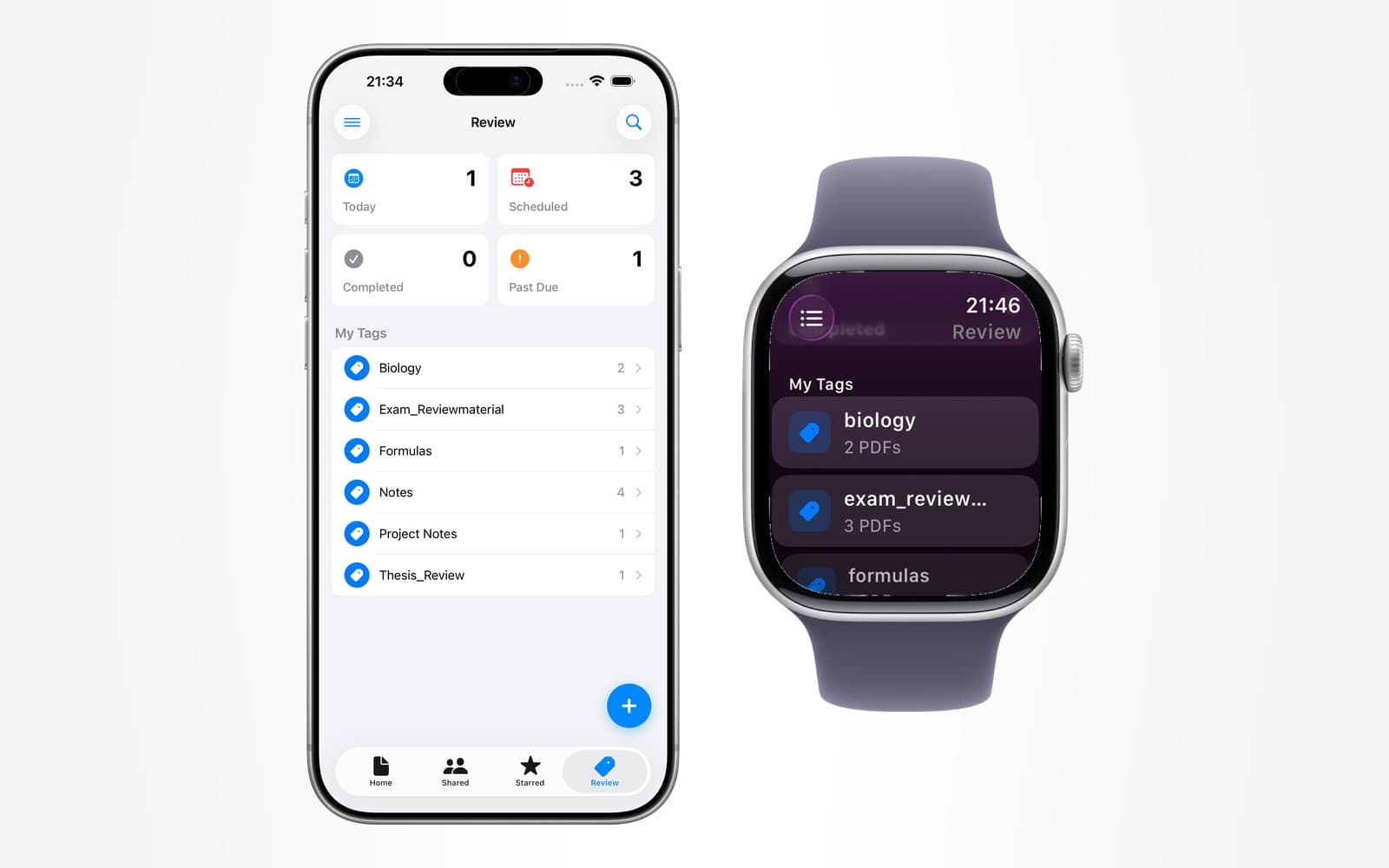
The practical route for most people is the material they already have. Lecture slides, a summary sheet, a set of definitions — imported on the phone, saved to the Watch, and paged through with the Digital Crown.
A one-idea-per-page document behaves exactly like a deck of cards: each turn of the Crown is a new prompt. Formatting a summary sheet this way takes a few minutes and turns a document you would have reread into one you can be tested by.
Some apps, including iWatch PDF, can also generate questions from a document you have imported, which removes the writing step for material you have not made cards for yet.
When should you actually review?
Spaced repetition — increasing the gap between reviews of material you get right — is the other well-supported finding worth using. You do not need a scheduling algorithm to benefit from the principle:
- Review new material the same day you first meet it.
- Again the next day.
- Then after roughly three days, a week, two weeks.
- Anything you get wrong goes back to the start of that sequence.
The specific intervals matter far less than the fact that they expand. Getting something right easily is a signal to wait longer, not to keep drilling it.
What this will not do
It will not replace sitting down with the material. Retrieval practice consolidates what you have already understood; it does not build the understanding in the first place. If you cannot follow the reasoning on a page, no amount of wrist testing will fix that — go back to the source.
It also will not help if you are answering on autopilot. The pause before you check the answer is where the work happens. A card you flip instantly is a card you did not study.
Frequently asked questions
Q: Do I need my iPhone nearby to study on Apple Watch?
A: No, as long as the material was saved to the Watch first. Documents stored on the device are read locally and work with the phone off or out of range.
Q: How many cards should one session be?
A: Ten to twenty is a natural size for a wrist session — around a minute or two. The point is frequency, not volume; six short sessions beat one long one.
Q: Is studying on a watch as effective as using paper cards?
A: For retrieval practice specifically, the medium matters much less than whether you actually attempt to recall before checking. The watch wins on how often you will do it, not on how well any single card works.
Q: What subjects suit this best?
A: Anything with discrete facts — vocabulary, anatomy, drug names, dates, formulae, definitions. Subjects that require working through a derivation or a long argument do not fit the format.
Q: Will this drain my battery during the day?
A: Short reading sessions are light. The heavier operation is transferring material to the Watch, which is best done on the charger.
The short version
Do not try to read on your wrist. Test yourself on it instead. Rewrite your material as single questions with short answers, sync it, and use the minutes you were going to spend on your phone anyway. The format constraint is the feature.
Read next
Revising for an Exam by Quizzing Yourself on Apple Watch
Turn a set of lecture notes into questions, then answer them from your wrist in the two-minute gaps you already have.
5 min read
How Students Can Use Apple Watch to Study Smarter (Not Just Track Fitness) – 2026
Three habits that turn scattered minutes into study time: reminders without unlocking your phone, capture by voice, and notes at a glance.
1 min read
Unlock Your iPhone With Your Apple Watch: Setup and Limits
It only works when something is covering your face, and the watch must be on your wrist and unlocked. Setup, and what it will not do.
3 min read